

100/100
Nysa Chaturvedi
Science · CBSE
JPHS
School Topper
Visionaries by Reena Rawal
Many students enter the IB Middle Years Programme expecting Science to reward accurate memory.
Instead, they discover a curriculum that asks them to investigate unfamiliar questions, analyse evidence, justify conclusions, evaluate limitations, communicate scientifically and reflect on their own thinking.
Success in the MYP depends not only on understanding Biology, Chemistry and Physics, but on developing the habits of scientific inquiry.
Visionaries prepares students across Grades 6 to 10 through structured academic mentorship aligned with the philosophy, assessment framework and inquiry-based approach of the International Baccalaureate Middle Years Programme.
Developing conceptual understanding, scientific inquiry, criterion-based performance and long-term readiness for the IB Diploma Programme.
Research question
How does the concentration of a reactant influence the rate of a reaction?
Variables
Independent: concentration
Dependent: time to endpoint
Controlled: temperature, volume
Evidence
Time decreases as concentration rises.
Anomaly at 0.4 mol/dm³ — repeat.
Progression of thinking
The composition communicates thinking, not experimentation.
“Science is no longer only about learning facts. It becomes a way of thinking.”
Students entering the MYP often expect Science to behave like a traditional subject. They anticipate chapters, definitions, worksheets and examinations that primarily reward recall.
Instead, the programme asks students to ask questions before receiving answers. To investigate before concluding. To justify rather than merely state. To evaluate rather than simply calculate. To connect scientific understanding with the wider world.
This difference often surprises even academically strong students — not because the Science becomes inherently more difficult, but because the expectations become fundamentally different.
Inquiry framework
Students continue searching for the correct answer when the assessment is measuring the quality of their reasoning.
Students memorise scientific content without recognising the conceptual relationships connecting different units.
Investigations become uncomfortable because there is no single prescribed procedure to follow.
Scientific writing becomes more demanding because evidence must support every conclusion.
Reflection feels unfamiliar because students are asked to evaluate not only the experiment but also their own learning.
Assessment criteria appear confusing because students are no longer receiving one overall Science mark. Instead, they are assessed across different scientific capabilities.
The challenge is rarely intelligence. The challenge is adapting to a different educational philosophy.
The International Baccalaureate approaches education differently from many traditional curricula. Rather than organising learning entirely around individual chapters and examinations, the MYP encourages students to explore concepts that extend across disciplines, investigate authentic questions and understand how knowledge applies beyond the classroom.
Science therefore becomes more than content. It becomes a framework for observing, questioning, analysing and understanding the world. Students are encouraged to become active participants in their own learning rather than passive recipients of information.
01
Students learn the principles connecting scientific ideas rather than treating every topic as isolated information.
02
Students investigate meaningful questions through observation, experimentation and evidence.
03
Students learn to explain scientific thinking clearly using appropriate terminology, diagrams, data and reasoning.
04
Students evaluate both scientific outcomes and their own learning processes.
05
Scientific ideas are explored within environmental, technological and societal contexts.
06
The objective extends beyond examination success. Students develop habits of thinking that remain valuable throughout higher education and professional life.
The MYP does not ask students to remember more Science. It asks them to become better scientific thinkers.
Many parents first encounter terms such as Statement of Inquiry during school meetings or report cards without fully understanding what they mean.
The Statement of Inquiry is not another learning objective. It is the central idea that connects everything the student explores throughout a unit.
Instead of asking students to simply learn scientific facts, the MYP asks them to understand a broader principle that can be transferred to unfamiliar situations. A well-designed Statement of Inquiry encourages students to think beyond the textbook and recognise that scientific ideas are interconnected rather than isolated.
For example, a unit about ecosystems is not only about food chains or biodiversity. It may instead explore a broader understanding such as how systems remain balanced through interaction and change. The factual content becomes the evidence through which the larger idea is understood.
Visionaries therefore begins every unit by helping students understand the larger conceptual purpose before teaching the individual scientific content. When students understand why they are learning something, retention, application and analytical thinking improve naturally.
Layer 1
Scientific Content
Facts, definitions, examples.
Layer 2
Conceptual Understanding
The principles connecting the facts.
Layer 3
Statement of Inquiry
The transferable idea that unifies the unit.
Students remember facts. Scientists understand ideas.
The IB MYP organises learning around broad concepts that continue appearing throughout different scientific disciplines. Rather than treating each topic as completely new, students repeatedly return to the same conceptual ideas from different perspectives.
At Visionaries, concepts become the framework through which individual lessons are organised. Instead of memorising disconnected information, students gradually recognise recurring scientific patterns.
Many scientific phenomena are made up of interconnected parts rather than isolated components. Students learn to understand relationships rather than individual facts.
Science explains how systems evolve over time. Students investigate causes, consequences and patterns of change.
Scientific ideas rarely exist independently. Students learn how variables, organisms, forces, particles and processes influence one another.
Energy appears repeatedly across Biology, Chemistry and Physics. Students learn how it is transferred, transformed and conserved.
Scientific understanding develops by studying how components influence one another within larger systems.
Scientific conclusions become meaningful only when supported by reliable evidence. Students learn that evidence should guide conclusions rather than assumptions.
Concepts remain. Individual examples change. Students who understand concepts adapt more confidently when contexts become unfamiliar.
Alongside broader concepts, MYP units also introduce related concepts that provide greater precision. These concepts allow students to examine scientific phenomena through increasingly specialised perspectives.
For example, within one unit students may explore ideas such as:
The specific related concepts vary according to the unit being studied. Visionaries therefore focuses not only on teaching the content itself but also helping students recognise the conceptual lens through which the unit is being explored.
Facts explain one situation. Concepts explain many.
The IB MYP intentionally connects scientific learning with authentic global issues. Rather than treating Science as an isolated academic subject, students explore how scientific knowledge influences individuals, societies and the natural world.
Learning therefore extends beyond examination preparation. Students are encouraged to recognise that scientific thinking has practical, ethical and environmental consequences.
Visionaries integrates these wider discussions naturally into academic teaching rather than presenting them as separate classroom conversations.
Scientific Innovation
How discoveries reshape industries, healthcare and technology.
Sustainability
Understanding environmental responsibility through scientific evidence.
Human Development
Exploring how scientific knowledge improves quality of life.
Global Challenges
Applying scientific reasoning to contemporary issues.
Ethical Decision Making
Recognising that scientific capability also requires responsible judgement.
Everyday Application
Helping students recognise Science within daily life rather than only inside laboratories.
Science becomes memorable when students understand why it exists.
One of the defining characteristics of the International Baccalaureate is its explicit focus on learning skills alongside academic knowledge. These are known as Approaches to Learning, or ATL Skills.
Rather than assuming students automatically develop effective study habits, communication, organisation and research abilities, the programme intentionally builds them throughout the curriculum. Visionaries supports these skills because they influence performance across every scientific investigation and assessment.
01
Thinking Skills
Students learn to analyse, evaluate, compare, question and solve unfamiliar scientific problems.
02
Research Skills
Students gather, interpret and evaluate scientific information from reliable sources.
03
Communication Skills
Students express scientific understanding clearly using evidence, terminology, diagrams and structured reasoning.
04
Self-Management Skills
Students develop organisation, planning, revision habits and responsible independent learning.
05
Collaboration Skills
Students learn to discuss, investigate and solve scientific problems respectfully with others.
The strongest students are rarely those who simply know the most. They are often the students who know how to learn most effectively.
One of the most common misconceptions about the MYP is that inquiry means allowing students to discover everything independently. Effective inquiry is far more structured than that.
Students are guided to ask meaningful questions, investigate evidence, test ideas and justify conclusions while receiving carefully designed academic support throughout the learning process.
At Visionaries, inquiry never replaces explicit teaching. Instead, explanation and investigation strengthen one another. Students first build reliable conceptual understanding before applying those ideas through inquiry.
Every stage strengthens a different aspect of scientific thinking. Removing any stage weakens the learning process.
Students can sometimes remember definitions, reproduce diagrams and complete familiar questions while still struggling to think like scientists.
Scientific thinking requires students to recognise patterns, interpret evidence, question assumptions, evaluate reliability and justify conclusions using logic rather than opinion.
Visionaries deliberately develops these habits throughout every stage of the programme. The objective is not simply to improve today's assessment. It is to strengthen the student's ability to approach unfamiliar scientific problems with confidence.
Observe Carefully
Recognise meaningful details before reaching conclusions.
Ask Better Questions
Good investigations begin with thoughtful questions rather than immediate answers.
Recognise Patterns
Identify relationships that connect different scientific ideas.
Evaluate Evidence
Understand the quality and limitations of available information.
Construct Explanations
Support every conclusion with scientific reasoning.
Reflect Thoughtfully
Improve future thinking by analysing previous decisions.
Scientific thinking is not a talent. It is a discipline developed through repeated practice.
Traditional learning often organises knowledge around individual chapters. The MYP instead encourages students to build transferable conceptual understanding.
Students who understand only one ecosystem question may struggle when the context changes. Students who understand the broader concept of systems can apply their thinking across biology, chemistry, environmental science and future learning.
Visionaries therefore organises teaching around enduring scientific ideas before expanding into specific examples, investigations and assessments.
Examinations eventually end. Conceptual understanding continues supporting future learning long afterwards.
Most traditional school systems produce one overall Science score. The MYP takes a different approach. Instead of measuring Science as a single ability, it separates scientific learning into distinct capabilities and assesses each independently.
A student may demonstrate excellent conceptual understanding while still needing to strengthen scientific investigation. Another student may design thoughtful experiments but struggle to communicate conclusions precisely.
Criterion-based assessment allows teachers to identify these differences clearly rather than reducing scientific ability to one overall percentage. For parents, this provides a more detailed picture of how a student learns. For students, it creates a clearer pathway for improvement. For teachers, it allows feedback to become more specific and more useful.
Visionaries structures learning around these same capabilities so that assessment becomes a natural extension of learning rather than a separate event.
Scientific ability is multi-dimensional.
Criterion A
Many parents naturally assume that Criterion A measures how much Science the student remembers. It certainly includes scientific knowledge. However, the criterion extends far beyond memorisation.
Students are expected to demonstrate understanding of scientific ideas, apply appropriate terminology, explain relationships, solve scientific problems and use their knowledge within unfamiliar situations.
A student who simply reproduces definitions without understanding underlying concepts may perform well on routine classroom questions while struggling in Criterion A assessments.
Visionaries therefore focuses on conceptual understanding before factual recall. Students learn not only what scientific ideas are, but why they work and how they connect with one another.
Visionaries develops this through
Students learn to
Scientific knowledge becomes dependable only when students understand the ideas beneath it.
Criterion B
Criterion B introduces one of the defining characteristics of the MYP. Students are no longer asked only to complete experiments. They must think like investigators before the experiment even begins.
Students learn how meaningful scientific investigations are planned. They identify research questions, determine variables, select appropriate methods, justify procedures and consider how evidence will eventually answer the original question.
Many students initially struggle because there is rarely one perfect investigation. Instead, they must defend why their chosen method is appropriate.
Visionaries therefore teaches experimental thinking before experimental execution. Students learn how investigations are constructed rather than simply copied.
Students learn to
Good experiments rarely happen by accident. They are designed thoughtfully long before observations begin.
Criterion C
Scientific investigations do not end when data has been collected. The real scientific thinking often begins afterwards.
Criterion C asks students to interpret evidence, recognise patterns, evaluate reliability, identify anomalies and construct conclusions supported by data.
Many students describe observations accurately but struggle to explain what those observations actually mean. Others reach conclusions that extend beyond the available evidence.
Visionaries teaches students to distinguish clearly between description, interpretation and evaluation. Students learn that evidence must support every scientific claim.
Visionaries develops this through
Scientific conclusions become trustworthy only when supported by evidence.
Criterion D
Criterion D often surprises families unfamiliar with the MYP. Students are encouraged to think beyond scientific content itself.
They explore how Science influences individuals, societies and the environment. They consider ethical questions, technological developments, sustainability, responsibility and the wider consequences of scientific advancement.
This criterion helps students understand that scientific knowledge exists within a broader human context.
Visionaries integrates these discussions naturally alongside academic teaching. Students learn that responsible scientific thinking considers both possibility and consequence.
Students learn to
Science changes the world. Students should understand both how and why.
Removing any one capability creates an incomplete scientific education. Visionaries therefore integrates all four throughout the learning journey rather than preparing students for individual criterion assessments in isolation.
A
Understanding
B
Investigation
C
Analysis
D
Reflection
A → B → C → D → back to A
Every investigation strengthens understanding.
Every new understanding improves future investigations.
Scientific learning becomes cyclical rather than linear.
One of the most important differences within the MYP is the distinction between formative and summative assessment. Parents sometimes interpret every classroom assessment as a final judgement.
The MYP approaches assessment differently. Some assessments exist primarily to guide learning. Others evaluate learning after development has occurred. Both are important. But they serve different purposes. Visionaries mirrors this philosophy throughout the programme.
Purpose
Support improvement.
Students receive detailed feedback. Mistakes become opportunities for growth. The emphasis remains on development rather than judgement.
Examples
Purpose
Demonstrate achievement.
Students independently apply understanding developed throughout the unit.
Examples
Learning happens before assessment. Assessment simply makes learning visible.
Many families transitioning into the MYP initially find school reports unfamiliar. Instead of seeing one overall Science score supported only by percentages, they encounter criterion levels that describe different aspects of scientific learning.
Visionaries helps families interpret these reports more clearly. Rather than asking only,
“What mark did my child receive?”
the more valuable questions become:
This perspective transforms assessment into a roadmap for future learning.
The purpose of feedback is not to judge learning. It is to improve it.
Every assessment completed within Visionaries should answer three questions.
01
What does the student currently understand?
02
What misunderstanding still exists?
03
What should happen next?
Assessment therefore becomes diagnostic rather than merely evaluative. Students receive structured feedback designed to strengthen future performance rather than simply explain previous mistakes.
The objective is continuous academic development rather than isolated assessment success.
The strongest assessment is the one that changes tomorrow's learning.
One of the defining characteristics of the IB Middle Years Programme is that students do not simply learn scientific knowledge. They learn how scientific knowledge is produced.
Students investigate questions, collect observations, interpret evidence and defend conclusions using logical reasoning.
An investigation therefore becomes far more than a practical activity. It becomes an opportunity to think, question, analyse and evaluate like a scientist.
Visionaries prepares students to approach investigations systematically so that every experiment strengthens conceptual understanding rather than becoming an isolated classroom exercise.
Science does not begin with answers. It begins with questions.
Every stage develops a different scientific capability. Removing one stage weakens the entire investigation.
Students often assume that scientific investigations begin once equipment is placed on the laboratory table. In reality, the quality of an investigation is determined much earlier. Everything begins with the question being investigated.
An effective scientific question should be clear, measurable and capable of being answered through evidence. Students therefore learn how to distinguish between broad curiosity and investigable scientific questions.
Visionaries helps students recognise that refining the question often improves the entire investigation.
Students learn to identify
A better question usually produces better Science.
Many students expect practical work to involve following a fixed set of instructions. The MYP instead asks students to justify why an investigation has been designed in a particular way.
Students consider fairness, reliability, safety, practicality and evidence before carrying out the procedure itself.
Visionaries develops experimental thinking by helping students understand why each design decision influences the quality of the final evidence.
Students develop the ability to
Careful planning reduces avoidable mistakes before they occur.
One of the earliest challenges for many students is identifying variables correctly. Rather than memorising definitions, students must understand how variables influence scientific evidence.
Visionaries teaches variable identification through repeated investigation scenarios rather than isolated terminology exercises.
The factor intentionally changed.
The factor measured or observed.
The conditions that remain consistent to ensure a fair investigation.
Why this matters
If important variables are not controlled, conclusions become less reliable. Students therefore learn not only to identify variables but also to justify why they matter.
Fair investigations require thoughtful control.
Evidence forms the foundation of every scientific conclusion. Students therefore learn that reliable observations require thoughtful measurement, accurate recording and careful organisation.
Visionaries encourages students to treat data collection as part of scientific reasoning rather than administrative note-taking.
Reliable evidence begins with careful observation.
Many students use these terms interchangeably. The MYP expects them to distinguish clearly between different qualities of scientific evidence. Visionaries develops these distinctions through repeated analysis of authentic investigation scenarios.
| Quality | Definition | In one word |
|---|---|---|
| Reliability | Can similar results be obtained repeatedly? | Consistency |
| Accuracy | How closely do the observations represent the true value? | Correctness |
| Validity | Did the investigation actually measure what it intended to investigate? | Appropriate Design |
Improvement — Students learn how thoughtful procedural changes strengthen future investigations.
Scientific confidence grows when evidence becomes trustworthy.
Students sometimes believe that successful experiments end once observations have been recorded. The MYP places equal importance on interpreting what the evidence actually means. Students therefore learn how to identify patterns, compare results, recognise anomalies and evaluate relationships before reaching conclusions.
Visionaries helps students move beyond describing information toward explaining scientific significance.
Students learn to analyse
Data becomes meaningful only after thoughtful interpretation.
Graph interpretation appears throughout MYP Science because visual evidence often reveals patterns that raw numbers cannot. Students learn how to interpret relationships, recognise trends and support conclusions using graphical evidence rather than intuition.
Visionaries develops graph interpretation through regular discussion rather than procedural memorisation.
Students learn to recognise
Every graph answers a question. Students first learn to recognise what that question is.
One of the most valuable habits developed within the MYP is disciplined reasoning. Students learn that conclusions should emerge naturally from observations rather than personal expectation.
Visionaries repeatedly encourages students to ask one important question.
“What evidence supports this conclusion?”
This habit strengthens scientific writing across every criterion.
Students develop the ability to
Evidence should guide conclusions. Not the other way around.
Evaluation is not simply identifying mistakes. Students analyse the quality of evidence, recognise limitations, explain uncertainty and recommend improvements that would strengthen future investigations.
Visionaries teaches evaluation as a constructive scientific process rather than self-criticism.
Students evaluate
What worked?
What limited it?
Why?
How to improve?
What was learned?
Every investigation improves the next one.
Students often possess stronger understanding than their written work demonstrates. The MYP therefore emphasises structured scientific communication alongside conceptual knowledge.
Visionaries helps students develop confidence expressing scientific ideas through appropriate language, evidence and logical organisation.
Students strengthen
Clear thinking deserves clear communication.
The strongest scientific reports are rarely the longest. They are the most carefully justified. Students therefore learn how to support every important statement using observations, calculations, graphs or experimental evidence.
Rather than encouraging unnecessary complexity, Visionaries teaches precision.
Students avoid
Scientific writing becomes persuasive because it is evidence-driven.
Every investigation reinforces conceptual learning. Every concept improves future investigations.
Visionaries therefore integrates inquiry, experimentation, communication and reflection throughout the programme rather than teaching them as independent skills.
Students gradually recognise that scientific understanding grows strongest when knowledge and investigation develop together.
Each pass returns to concept — but at a deeper conceptual level.
Students do not become stronger scientists by completing more experiments. They become stronger scientists by understanding what every investigation teaches them.
Understanding the International Baccalaureate Middle Years Programme requires a different educational approach from traditional Science tuition. Students are not assessed only on the accuracy of answers. They are assessed on how they investigate, communicate, evaluate and apply scientific understanding across unfamiliar situations.
Visionaries therefore designs every learning experience around the educational philosophy of the MYP rather than reducing lessons to chapter completion.
Scientific knowledge remains essential. But equally important is developing curiosity, conceptual understanding, disciplined reasoning and independent thinking.
Our objective is not simply to prepare students for the next assessment. It is to help them become increasingly confident scientific learners.
We do not teach around the assessment. We teach around the learner.
Rather than treating learning as a sequence of lectures followed by homework, Visionaries follows a deliberate instructional framework that mirrors the inquiry-based philosophy of the MYP.
Students are guided from first understanding an idea, to applying it in unfamiliar situations, to reflecting on how that understanding can be strengthened further. This creates continuity between lessons and encourages long-term retention instead of short-term memorisation.
Each pass returns to understand — but at a more advanced level of understanding.
Each stage develops a different aspect of scientific thinking. Together, they create deeper and more transferable understanding.
Students frequently struggle when new information is presented before they understand the larger scientific idea. Visionaries therefore begins with the central concept.
Only after students understand the underlying principle do lessons expand into terminology, examples, calculations, investigations and assessment tasks.
This approach reduces cognitive overload and helps students recognise connections across different units.
Students learn more efficiently when every detail has a conceptual home.
Inquiry is often misunderstood as leaving students to discover everything on their own. Visionaries approaches inquiry differently.
Students receive carefully structured guidance that encourages independent thinking without removing academic support. Teachers ask progressively deeper questions, encourage justification, challenge assumptions and help students recognise alternative explanations.
The goal is not simply to provide answers. It is to help students become increasingly capable of finding and defending their own.
Confidence grows when students understand how they reached an answer.
For students who benefit from personalised pacing, Visionaries offers one-to-one learning aligned with the MYP framework.
Sessions are adapted to the student's conceptual understanding, current school curriculum, assessment timeline and individual learning needs.
This allows greater flexibility for exploring misconceptions, strengthening investigations and preparing for criterion-based assessments. The emphasis remains on understanding rather than acceleration.
Learning becomes more effective when teaching responds to the individual student.
Scientific learning becomes richer when students encounter different perspectives. Visionaries therefore offers carefully curated small groups where academic compatibility, learning pace and programme objectives remain closely aligned.
These are not large classroom batches. Each group is intentionally kept small to encourage participation, questioning and collaborative reasoning.
Teachers continue monitoring individual progress while using discussion to deepen conceptual understanding.
Meaningful discussion often strengthens understanding that independent study cannot.
Monitoring academic development requires more than recording completed lessons. Visionaries continually observes how students explain concepts, approach investigations, interpret evidence and apply feedback across different learning situations.
Progress therefore reflects growth in scientific capability rather than only syllabus completion.
Meaningful progress becomes visible through increasingly sophisticated thinking.
Every piece of feedback should answer three questions.
01
What was done well?
02
What could become stronger?
03
What should happen next?
Students therefore receive direction rather than judgement. Feedback remains specific, actionable and connected to future learning.
Good feedback changes the next attempt.
The MYP often introduces unfamiliar terminology and assessment structures. Visionaries believes that parents should understand these educational principles alongside their children.
When families recognise how criterion-based assessment, inquiry and conceptual learning operate, conversations about progress become more constructive and less focused solely on marks.
Confident learners are often supported by informed families.
The Middle Years Programme is designed as preparation for increasingly advanced academic study. Students who develop strong conceptual understanding, scientific communication, investigative thinking and reflective habits during the MYP are often better prepared for the intellectual demands of the IB Diploma Programme.
Visionaries therefore focuses not only on immediate school performance but also on building capabilities that remain valuable in future Biology, Chemistry and Physics courses.
The strongest preparation for future learning begins long before the future arrives.
Phase 1
Understand
Establish conceptual foundations, identify learning gaps and build confidence with the MYP framework.
Phase 2
Apply
Develop scientific reasoning through discussion, investigations, criterion-focused tasks and unfamiliar applications.
Phase 3
Evaluate
Strengthen interpretation, communication, evaluation and reflective thinking using structured feedback.
Phase 4
Progress
Continue refining conceptual understanding while preparing confidently for future units and long-term academic development.
Every phase builds upon the previous one. Scientific understanding develops through continuity, not isolated lessons.
The Visionaries IB MYP Sciences Programme is designed for students who want to build lasting scientific capability rather than prepare only for the next school assessment.
Some students join because they have recently transitioned into the International Baccalaureate and want greater confidence with the MYP framework. Others are already performing well academically but recognise that the programme increasingly rewards conceptual understanding, investigation and independent reasoning rather than memorisation alone.
The programme adapts to different starting points while maintaining the same educational philosophy.
Students who want to understand scientific ideas rather than memorise isolated facts.
Students who wish to become more confident with criterion-based assessments.
Students who want structured support with investigations, scientific writing and data interpretation.
Students who are preparing for increasingly demanding MYP assessments across Grades 6–10.
Students who enjoy asking questions and exploring how scientific ideas connect.
Students who want to build stronger foundations before progressing into the IB Diploma Programme.
The programme supports curiosity with structure and ambition with thoughtful academic guidance.
Maintaining academic alignment is important for both students and families. Visionaries is designed for learners who are willing to engage with ideas, ask questions and develop their understanding over time.
Students seeking only last-minute examination preparation or answer memorisation may find that the programme approaches Science differently. The emphasis remains on sustained intellectual development rather than short-term coaching.
Better suited for students who…
Less suited for students seeking only…
Long-term scientific confidence cannot be built through short-term habits alone.
Stage 1
Orientation
Students become familiar with the expectations, language and philosophy of the MYP while identifying current strengths and learning priorities.
Stage 2
Conceptual Foundation
Core scientific ideas are strengthened before increasing complexity is introduced.
Stage 3
Application
Students begin applying concepts through discussions, investigations, unfamiliar scenarios and criterion-focused tasks.
Stage 4
Independent Thinking
Students become increasingly confident constructing explanations, analysing evidence and evaluating scientific ideas independently.
Stage 5
Long-Term Readiness
Students continue developing transferable scientific thinking that supports future academic progression.
Every stage prepares students for the next. Progress is cumulative rather than episodic.
The International Baccalaureate often introduces unfamiliar educational language and assessment structures. Visionaries believes parents should understand this journey as clearly as students.
As conceptual understanding develops, families become better equipped to interpret feedback, recognise meaningful progress and support learning beyond individual assessments.
Educational partnership becomes stronger when expectations are shared.
The most valuable outcomes of the programme cannot always be measured by one assessment. Students gradually become more confident discussing scientific ideas, interpreting unfamiliar information, planning investigations and communicating evidence with greater precision.
These capabilities often strengthen performance across school assessments while also preparing students for future academic study.
Students frequently develop stronger
The objective is not only stronger performance today. It is stronger learning tomorrow.
Evidence of Consistent Outcomes
Institutional proof is presented in the same visual language across the website. IB MYP outcomes will appear here as students consent to being featured; until then, verified results from CBSE, ICSE and IGCSE are shown as evidence of the same teaching method at work.
100/100
Nysa Chaturvedi
Science · CBSE
JPHS
School Topper
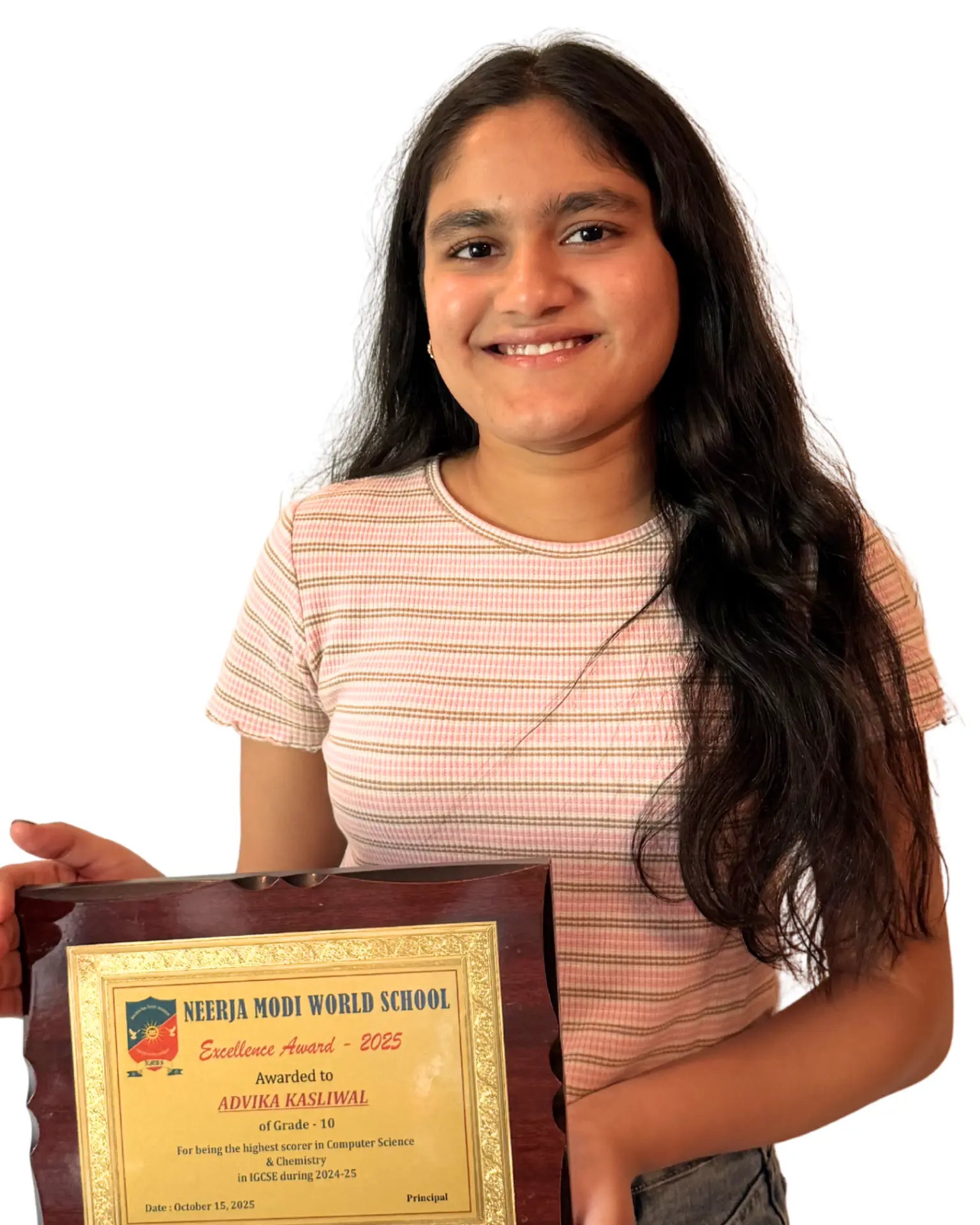
A*
Advika Kasliwal
Chemistry · IGCSE
NMWS
School Topper

100/100
Vaibhav
Science · CBSE
JPHS
School Topper
97/100
Manaswini
Science · ICSE
Mayo College Girls' School

99/100
Kushagra Kinra
Science · CBSE
St. Anselm's, Malviya Nagar
A*
Adhya Gupta
Chemistry · IGCSE
Choithram International School
Explore other programmes
Structured mastery of Grade 9 and 10 Science built on precision, conceptual depth and disciplined preparation.
Explore ProgrammeCambridgeThree-year Cambridge Science pathway beginning in Grade 8, covering Biology, Chemistry and Physics as one connected foundation.
Explore ProgrammeCambridgeComprehensive IGCSE preparation focused on concept mastery, application and examination performance across Science and Chemistry.
Explore ProgrammeICSEICSE Science mentorship built on conceptual depth, scientific communication and precise answer writing.
Explore ProgrammeEvery student's learning journey begins from a different point. Some are adapting to the International Baccalaureate for the first time. Others are seeking greater confidence with investigations, criterion-based assessments or conceptual understanding.
The first step is understanding where the student currently stands and identifying the most appropriate pathway forward.
A conversation with Visionaries provides an opportunity to discuss academic goals, current challenges and how the programme aligns with the philosophy of the IB Middle Years Programme.
Structured academic mentorship for students studying IB MYP Sciences across Grades 6–10.