
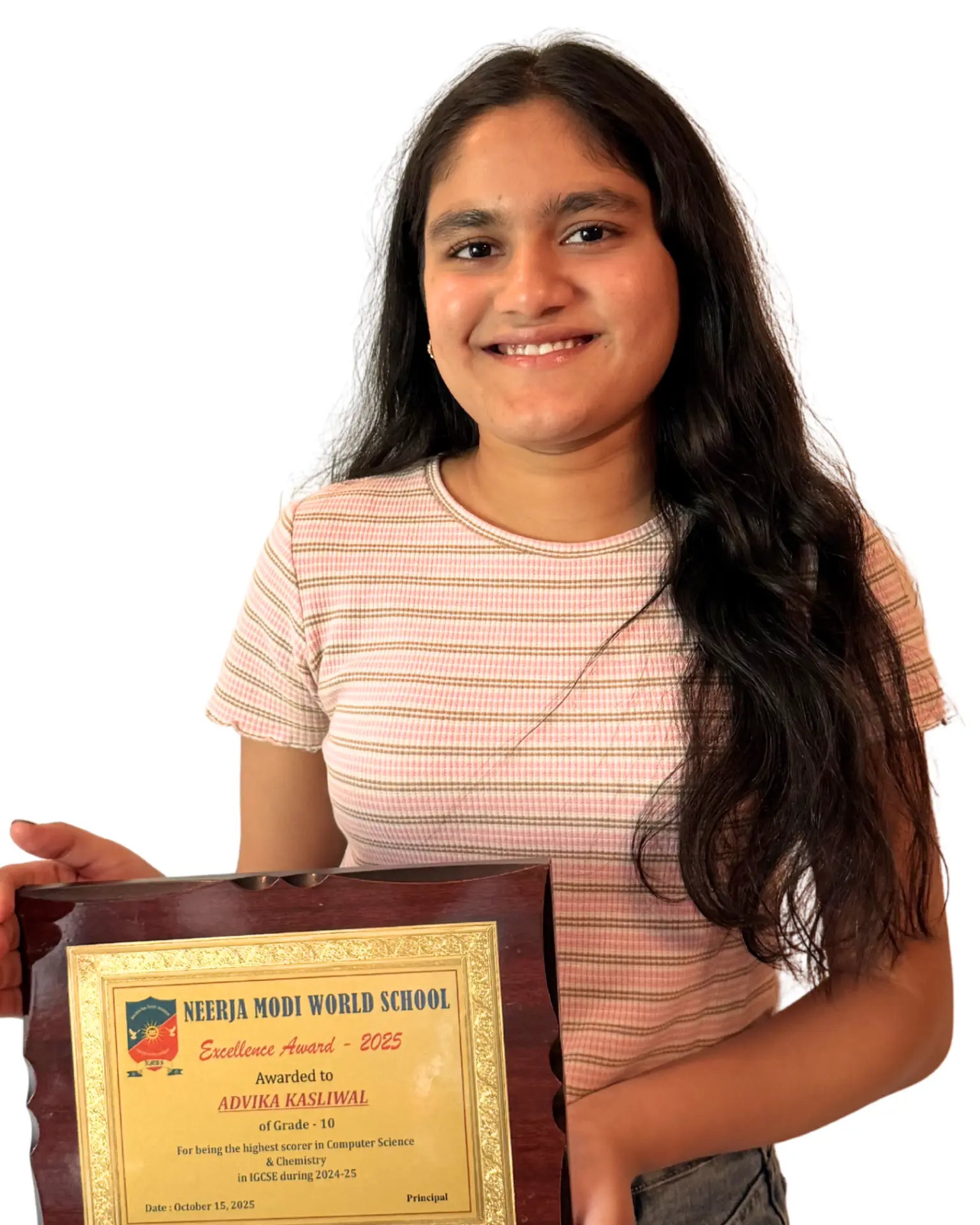
Advika Kasliwal
A*Chemistry · IGCSE
NMWS
School Topper
Visionaries by Reena Rawal
Cambridge IGCSE Chemistry asks students to move continuously between the microscopic and the observable — particles with bonding, bonding with structure, equations with quantities, observations with inference.
Visionaries builds this complete Chemistry system through live online one-to-one and highly focused small-group instruction for students preparing across Grades 9 and 10.
Structure
H — O — H
Bent molecular geometry · polar covalent bonds.
Balanced equation
2H2 + O2 → 2H2O
Exothermic. Combustion of hydrogen.
Mark-scheme note
“Observation: colourless gas produced. Explanation: hydrogen ions gain electrons at the cathode to form hydrogen molecules.”
Verified Cambridge IGCSE Chemistry Outcomes
Before explaining the programme in detail, here is the academic evidence behind it. These Visionaries students achieved A* in Cambridge IGCSE Chemistry through structured concept-building, disciplined practice, precise written responses and board-specific preparation.
Chemistry · IGCSE
NMWS
School Topper
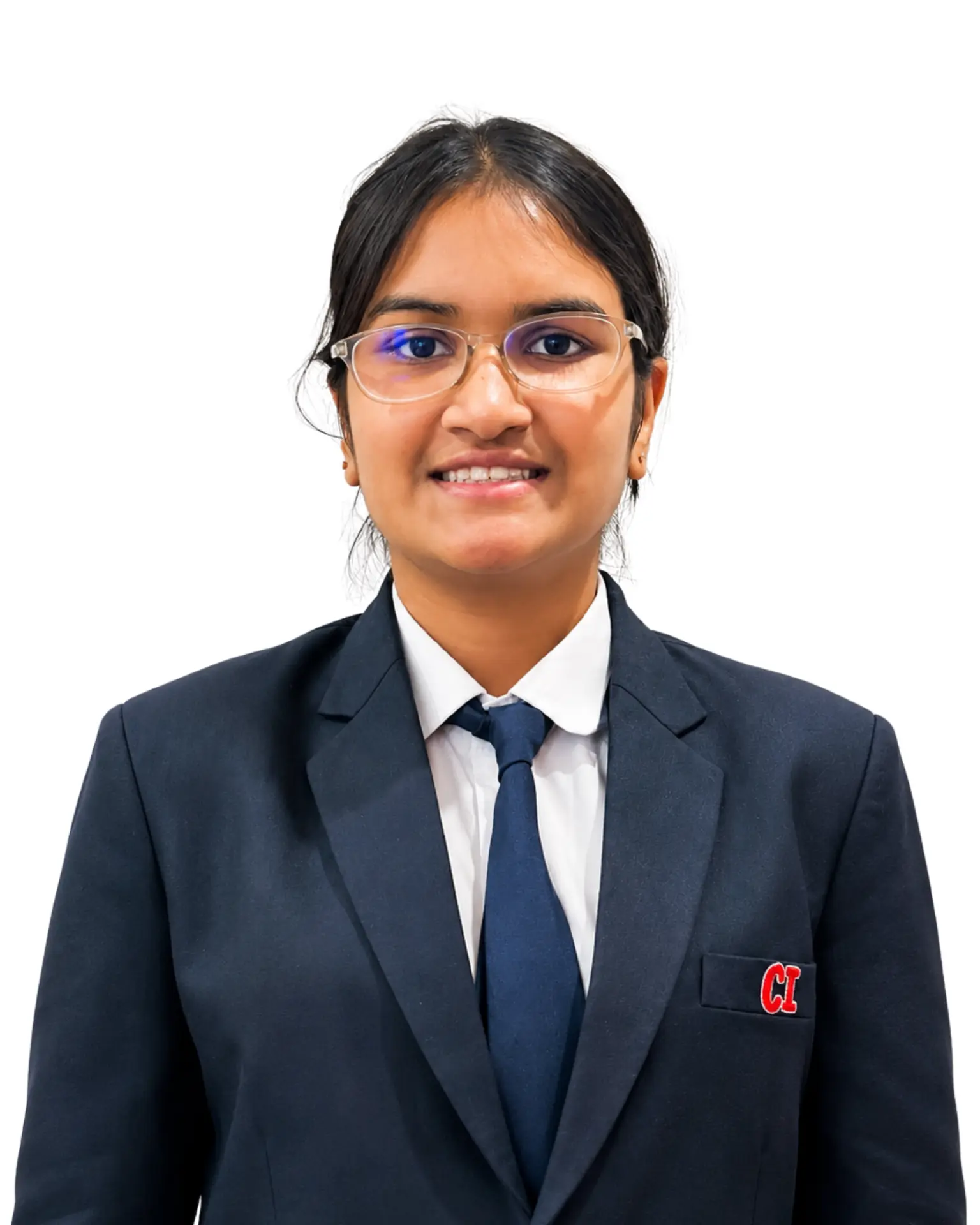
Chemistry · IGCSE
Choithram International School

Chemistry · IGCSE
NMWS
A student may believe atomic structure is understood until bonding begins. Bonding may feel clear until structure and properties must be explained. Each weak link quietly limits the topics that follow.
Where the marks actually go
Definitions are remembered without the underlying model.
The student may reproduce a definition but becomes uncertain when the same idea appears inside an explanation, comparison or unfamiliar context.
Chemical equations are treated as symbols to memorise.
A familiar equation may be recalled without understanding what each formula represents, why the reaction occurs or how the equation connects with particles and quantities.
Quantitative Chemistry is approached as formula selection.
The student looks for a remembered format instead of identifying the chemical relationship, the balanced equation, the mole ratio, the units and the sequence of calculation.
Observations and explanations are confused.
A visible colour change, precipitate or temperature change is an observation. The particle-level reason behind it is an explanation. Cambridge questions frequently ask students to separate the two.
Practical work is revised as apparatus vocabulary.
Naming a burette or pipette is not enough. Students must understand why an apparatus is chosen, what is being changed, what must be controlled, and what conclusion the evidence supports.
Answers contain Chemistry, but not the Chemistry the question requires.
A broadly relevant paragraph can still lose marks if the required comparison, keyword, particle explanation or conclusion is missing.
Past papers begin before the syllabus is connected.
Completing papers without diagnosis reinforces guessing. Past-paper work becomes valuable only when errors are classified, explained and revisited.
The remedy is not more Chemistry content. It is a stronger Chemistry system.
The programme follows the Cambridge IGCSE Chemistry syllabus applicable to the student's examination year. Cambridge identifies the syllabus year according to the calendar year in which the examination is taken, so alignment is determined by the student's actual examination session.
Coverage
Visionaries teaching emphasis
A correct property is not enough. The student must explain why the substance has it.
Coverage
Visionaries teaching emphasis
The calculation begins with Chemistry, not with the calculator.
Coverage
Visionaries teaching emphasis
A graph, an equation and a particle explanation may all describe the same reaction.
Coverage
Visionaries teaching emphasis
In analytical Chemistry, a correct conclusion is only as strong as the evidence used to reach it.
Coverage
Visionaries teaching emphasis
Patterns become useful only when the student can explain and apply them.
Coverage
Visionaries teaching emphasis
Coverage
Visionaries teaching emphasis
When the pattern is understood, Organic Chemistry becomes less dependent on disconnected memorisation.
The student's school entry route and examination target must be identified before preparation is finalised.
Where a student is preparing for Extended assessment, teaching must develop greater depth, multi-stage reasoning, quantitative control and the ability to handle less familiar questions.
The teaching pathway is aligned with:
Visionaries prepares the student according to the syllabus and assessment route confirmed by the family and school.
Chemistry becomes dependable when the student can move between what cannot be seen and what can be measured — and can do so without support.
Every topic in the programme is taught, tested and corrected against these seven capabilities — not against how many chapters have been covered.
Worked reasoning sheet
Stoichiometry
Identify the chemical event
What reaction or process is taking place?
Represent it accurately
Is a balanced equation required?
Identify what is known
Mass, volume, concentration, moles, gas volume, composition or yield.
Convert to a common chemical quantity
Students learn when and why a quantity must be converted into moles.
Use the chemical ratio
The balanced equation provides the relationship.
Convert to the required answer
Return from the mole relationship to the quantity requested.
Check units and plausibility
The final answer must be numerically and chemically sensible.
Students learn a transferable reasoning structure that remains usable when the substances, numbers or wording change.
Cambridge expects students to understand how experimental evidence is obtained, recorded, interpreted and evaluated — including those taking an Alternative to Practical route.
Apparatus selection
Why is one instrument more appropriate than another?
Variables
What is changed, measured and controlled?
Method design
Can the student describe a procedure that could actually produce valid evidence?
Observation
What can be directly seen, measured or recorded?
Inference
What chemical conclusion is supported by the observation?
Evaluation
What limitation affected the evidence, and how could the method improve?
Precision panel
Observation is not explanation.
State
Give the required fact, value, term or conclusion directly.
Describe
Present what happens, what is observed or what the data shows.
Explain
Connect the result with the relevant chemical principle.
Suggest
Use Chemistry and the available evidence to propose a plausible response.
Calculate
Show an ordered method, substitution, units and final answer.
Determine
Use the available information to reach a result or conclusion.
Compare
Identify relevant similarities and differences using a consistent basis.
Predict
Apply an established chemical pattern or principle to a new situation.
Deduce
Reach a conclusion by combining evidence with chemical knowledge.
Evaluate
Judge the quality, limitation or significance of evidence or method.
Before the student moves to the next question
A student may know the topic and still answer the wrong question. Visionaries teaches the student to recognise the demand before responding.
Past-paper work becomes meaningful once the student has enough Chemistry to interpret the question and enough feedback to understand why marks were lost.
Topic mastery
Develop concepts, equations, calculations and practical reasoning within individual syllabus areas.
Structured topic testing
Check whether the student can retrieve and apply the topic independently.
Mixed-topic retrieval
Bring together Chemistry the student has previously studied.
Paper-specific preparation
Develop familiarity with the relevant assessment formats and question demands.
Full examination practice
Integrate time, question selection, calculation control, practical reasoning and answer precision.
Error classification
Every important mistake is assigned to one of the following categories, so a test decides what happens next rather than only producing a mark.
A Grade 9 entrant begins with the advantage of time — the syllabus can be sequenced, revisited and revised across two academic years. A Grade 10 entrant does not need a smaller syllabus but a more concentrated academic system: rapid diagnosis, accelerated teaching and integrated examination preparation within a single year.
Pathway One
Two-year Cambridge IGCSE Chemistry programme
Time is used to build the syllabus progressively, return to earlier learning, develop practical thinking, strengthen quantitative Chemistry and create repeated opportunities for correction before examination pressure begins.
Programme priorities
Complete programme fee
₹5,00,000
Complete two-year Grade 9 and Grade 10 programme. Not an annual fee.
Pathway Two
One-year complete fast-track programme
The programme diagnoses current understanding, identifies what has been taught but not secured, covers the complete relevant syllabus, and moves into examination preparation within a shorter period. It is not a reduced course.
Programme priorities
Complete programme fee
₹4,20,000
Complete relevant syllabus delivered through a faster, more intensive academic schedule.
Every student in the programme is either taught alone or as one of three or four learners. There is no large batch reduced to a smaller screen.
Format One
Appropriate when the student requires a highly individual pace, significant syllabus recovery, accelerated Grade 10 preparation or close attention to recurring misconceptions.
Format Two
Designed to retain active questioning, individual accountability and meaningful teacher attention while allowing students to learn through comparison, discussion and shared problem-solving.

Visionaries by Reena Rawal is shaped by an academic philosophy developed through sustained classroom experience. The teaching begins by identifying not only whether an answer is wrong, but why it became wrong.
This diagnostic approach informs how Visionaries teaches, tests, corrects and revises Chemistry.
Broader Cambridge Chemistry Roster
Beyond the three A* results shown above, these Visionaries students completed Cambridge IGCSE Chemistry with strong grades — each prepared board-by-board, chapter-by-chapter.

A
Gauri Sharma
Chemistry · IGCSE
NMWS

A
Aarav Mehta
Chemistry · IGCSE
NMWS

A
Adharvya Rajbabutta
Chemistry · IGCSE
NMWS
The programme may be suitable when:
Related Cambridge Pathways
Beginning Cambridge in Grade 8? Explore Cambridge Lower Secondary Science — the three-year academic pathway into IGCSE Chemistry.
Explore other programmes
Structured mastery of Grade 9 and 10 Science built on precision, conceptual depth and disciplined preparation.
Explore ProgrammeCambridgeThree-year Cambridge Science pathway beginning in Grade 8, covering Biology, Chemistry and Physics as one connected foundation.
Explore ProgrammeIBInquiry-led IB MYP Sciences mentorship across Biology, Chemistry, Physics and Integrated Sciences.
Explore ProgrammeICSEICSE Science mentorship built on conceptual depth, scientific communication and precise answer writing.
Explore ProgrammeLive online Cambridge IGCSE Chemistry preparation through one-to-one instruction and highly focused small groups, for students entering in Grade 9 or Grade 10.
Grade 9 Entry
Two-year complete programme
₹5,00,000
Grade 10 Entry
One-year complete fast-track programme
₹4,20,000